The American Veterinary Medical Association (AVMA) reports that dog park incidents account for a significant portion of dog bite injuries and emergency veterinary visits each year. Off-leash socialization provides valuable mental stimulation and exercise, but only when owners understand canine body language, conflict prevention, and basic etiquette rules. Following these 10 evidence-based guidelines — supported by the AVMA, ASPCA, and the American Kennel Club (AKC) — can make the difference between a positive socialization experience and a traumatic one.
What Are the 10 Essential Dog Park Rules?
These rules are recommended by veterinary behaviorists and certified dog trainers (CPDT-KA) to minimize conflict and injury during off-leash play.
Always supervise actively — put your phone away and watch your dog
The ASPCA identifies distracted owners as the #1 contributing factor in dog park incidents.
Ensure your dog has reliable recall before going off-leash
A strong 'come' command is a safety tool, not a trick. Practice in controlled environments first.
Remove collars and harnesses that other dogs could get caught on
Dangling tags and harness straps can trap jaws during play, causing panic and injury.
Don't bring food or high-value treats into the park
Food triggers resource guarding in many dogs, escalating play into aggression.
Leave immediately if your dog shows fear, aggression, or excessive arousal
A tucked tail, whale eye, or frantic pacing are signs your dog is over threshold.
Use appropriate size areas — small and large dogs should be separated
The AKC recommends small dogs (under 25 lbs) use designated areas to prevent injury.
Pick up after your dog immediately
Intestinal parasites (roundworms, hookworms, giardia) spread through feces. The CAPC recommends prompt cleanup.
Don't bring puppies under 4 months or unvaccinated dogs
Parvovirus can survive in soil for up to a year. Full vaccination is essential before park visits.
Interrupt mounting, pinning, and one-sided chasing after 2–3 seconds
These behaviors escalate to conflict if left unchecked, even when they start as play.
Learn the difference between play and aggression
Healthy play has role reversals and self-handicapping. Aggression is stiff, one-sided, and escalating.
How Can You Tell If Dogs Are Playing or Fighting?
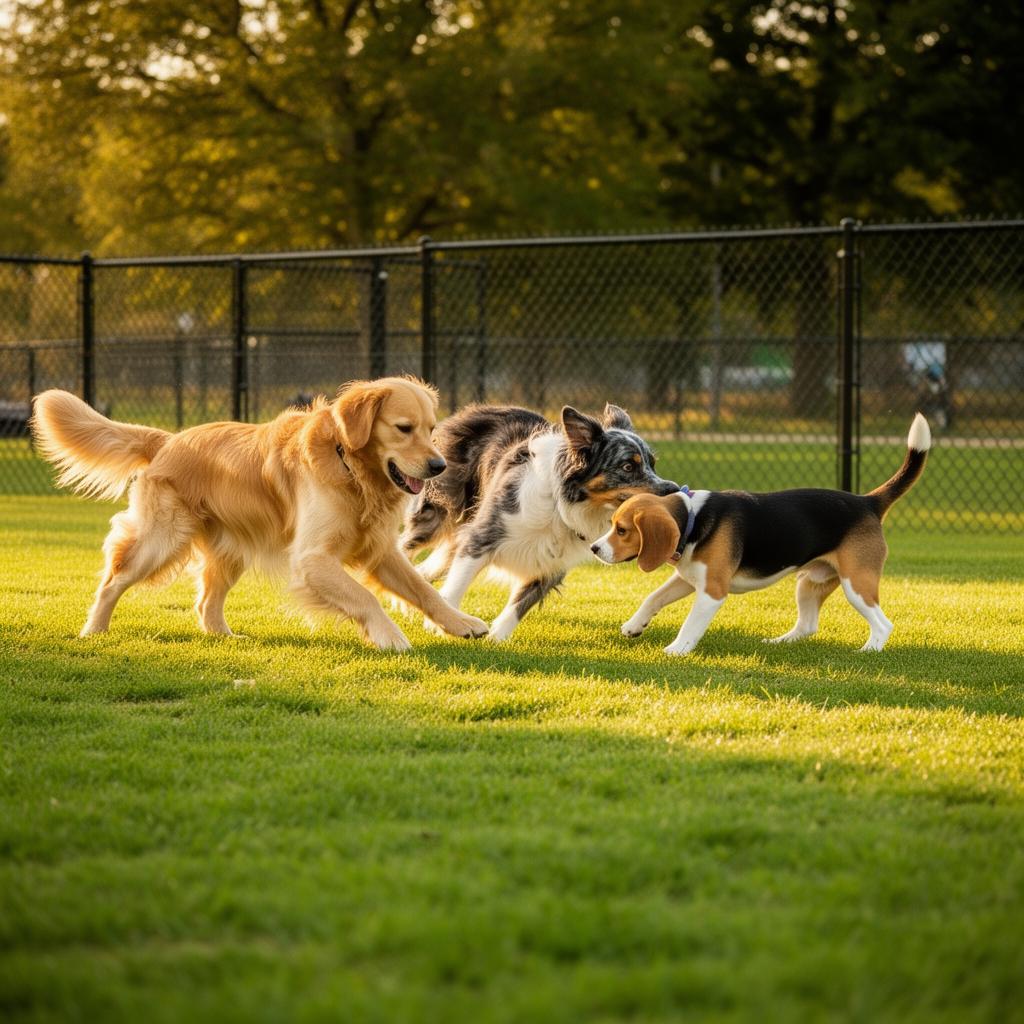
Reading canine body language is the single most important skill for safe dog park visits. The ASPCA's behavioral guidelines identify these key signals:
Signs of Healthy Play
- Play bows — front end drops while rear stays up, inviting engagement
- Role reversals — the chaser becomes the chased, indicating mutual consent
- Self-handicapping — larger dogs voluntarily slow down or lie down for smaller partners
- Voluntary pauses — dogs briefly stop, shake off, then re-engage
- Loose, wiggly body — relaxed muscles, open mouth, soft eyes
Warning Signs of Escalation
- Stiff body posture — tension throughout the body, weight shifted forward
- Hard staring — direct, unblinking eye contact is a threat signal
- Raised hackles — piloerection along the back indicates high arousal
- Pinning — standing over or pushing another dog to the ground
- One-sided pursuit — chasing without role reversals or pauses
The 3-Second Rule
If any interaction lasts more than 3 seconds without a pause or role reversal, calmly intervene. Call your dog away, create distance, and allow both dogs to reset before re-engaging.
How Should You Introduce Your Dog to a Dog Park?
A dog's first park experience can shape their lifelong attitude toward off-leash socialization. Certified Professional Dog Trainers (CPDT-KA) recommend this step-by-step introduction protocol:
- 1
Observe from outside the fence
Before entering, watch the dogs already inside for 5 minutes. Assess energy levels and group size. Avoid entering if dogs are overly aroused or a large pack is playing roughly.
- 2
Enter through the double gate
Use the airlock-style double gate. Remove your dog's leash between the gates — never enter the main area with a leash on, as it creates tension and restricts escape behavior.
- 3
Stay near the entrance
Allow your dog to explore at their own pace. Stay near the entrance for the first 2–3 minutes so you can exit quickly if needed.
- 4
Watch body language continuously
Monitor for loose, wiggly body language (good) versus stiff posture, hard stares, or tucked tails (bad). Intervene early at the first sign of discomfort.
- 5
Keep visits short initially
Limit first visits to 15–20 minutes. Overstimulation leads to poor behavior. End on a positive note before your dog becomes tired or overly aroused.
Which Dogs Should Avoid Dog Parks?
Dog parks are not suitable for every dog. The AVMA and the Association of Professional Dog Trainers (APDT) recommend avoiding off-leash parks for dogs that exhibit:
- Fear or anxiety — dogs that cower, hide behind owners, or panic around unfamiliar dogs
- Reactivity or aggression — dogs that lunge, bark aggressively, or fixate on other dogs
- Resource guarding — dogs that protect toys, food, water bowls, or their owner
- No recall — dogs that cannot be reliably called back in distracting environments
- Incomplete vaccination — puppies under 16 weeks or dogs without current core vaccines
For these dogs, the CPDT-KA recommends structured socialization alternatives such as small playgroups, controlled introductions, or parallel walking with calm dogs.
What Are the Health Risks at Dog Parks?
Beyond behavioral risks, dog parks present specific health hazards that owners should be aware of:
- Parasites: The Companion Animal Parasite Council (CAPC) warns that communal areas are high-risk for fleas, ticks, giardia, roundworms, and hookworms
- Kennel cough: Bordetella bronchiseptica spreads rapidly in enclosed, multi-dog environments
- Canine influenza: The highly contagious H3N2 and H3N8 strains can circulate through dog parks
- Heat-related illness: Dogs can overheat quickly during vigorous play — always bring fresh water
Ensure your dog is current on all core and lifestyle vaccines and on year-round parasite prevention before visiting dog parks.
Important Notice
Not all dogs are suited for dog parks. Dogs with fear, reactivity, aggression, or resource guarding should avoid off-leash environments. Consult a Certified Professional Dog Trainer (CPDT-KA) or a board-certified veterinary behaviorist (DACVB) for individualized socialization plans.