How Does "Catification" and Environmental Design Reduce Feline Anxiety?
Feline behavior is increasingly treated as a physical medical issue that can be addressed through "Environmental Design." Cats possess an evolutionary drive for height, stemming from their history as both ambush predators and prey. Dr. Sharon Crowell-Davis and other veterinary behaviorists suggest that denying a cat access to vertical space is equivalent to denying a core biological necessity, which leads to chronic stress and behavioral problems.
The term "catification," popularized by animal behaviorist Jackson Galaxy, refers to the intentional modification of indoor spaces to meet a cat's environmental and psychological needs. This isn't interior decoration—it's behavioral medicine expressed through architecture.
What Are the Psychological Benefits of Vertical Space for Cats?
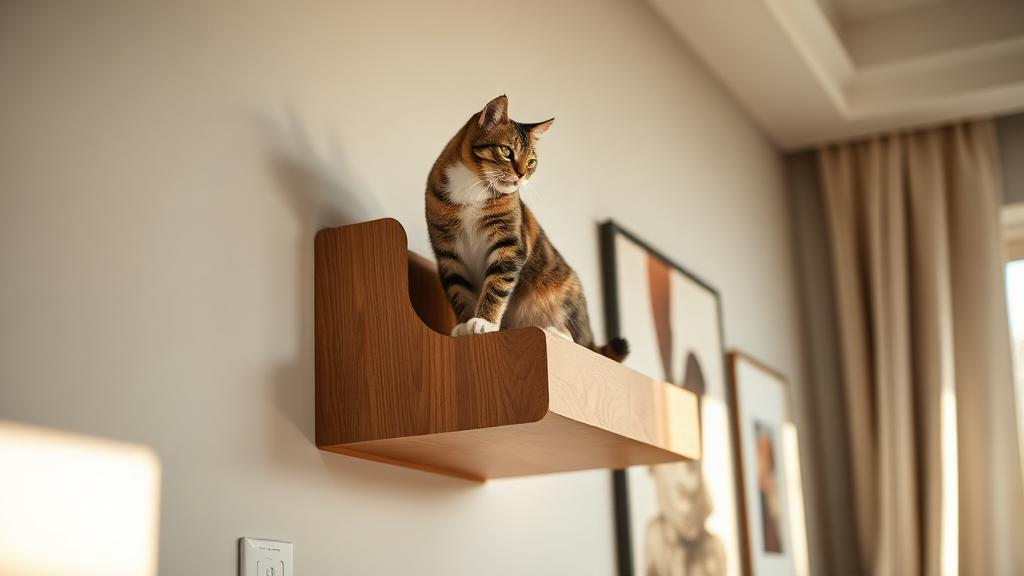
Research shows that catification—the addition of wall-mounted shelves, perches, and vertical walkways—significantly improves mental well-being in indoor environments:
Territorial Confidence
Height allows a cat to survey its territory and assert dominance without physical conflict, which is critical in multi-cat households. In feline social hierarchies, the cat with access to the highest point holds the most secure social position. Without vertical options, cats resort to ground-level confrontations—hissing, swatting, and blocking access to resources like food bowls and litter boxes.
Stress Mitigation
Elevated perches provide a safe haven from perceived "threats" such as loud noises, dogs, or small children. A study published in Applied Animal Behaviour Science found that shelter cats given access to elevated hiding spots showed significantly lower cortisol levels within the first 72 hours compared to cats in standard enclosures. The principle scales directly to home environments.
Reduced Aggression
A 2016 study using stand-alone shelving (commonly referred to as the "Ikea Kallax study") found that exploiting vertical space reduced unfriendly interactions among cohabiting cats. When cats can resolve territorial disputes through vertical positioning rather than physical altercation, inter-cat aggression drops measurably—often within the first two weeks of environmental modification.
Physical Health
Climbing and jumping engage core muscles and joints, helping to manage weight and prevent obesity, which currently affects 60% of domestic cats according to the Association for Pet Obesity Prevention (APOP). A catified environment transforms passive indoor living into an active landscape, with studies showing up to a 25% increase in daily activity levels when vertical routes are introduced.
| Benefit | Mechanism | Evidence |
|---|---|---|
| Territorial confidence | Height-based hierarchy resolution | Reduces ground-level confrontations in multi-cat homes |
| Stress reduction | Elevated safe havens from threats | Lower cortisol levels within 72 hours |
| Aggression reduction | Vertical conflict displacement | 2016 Kallax study: fewer unfriendly interactions |
| Weight management | Climbing engages core muscles | Up to 25% increase in daily activity |
What Does a Properly "Catified" Home Look Like?
Effective catification isn't about scattering cat trees randomly throughout a room. It follows principles rooted in feline ethology:
- Continuous Vertical Pathways: Wall-mounted shelves should connect to form routes, not dead ends. Cats need the ability to move through a room at elevation, not just sit on a single perch. Think of it as a "highway system" rather than parking spots.
- Multiple Access Points: No cat should be "trapped" on a perch by another cat blocking the only route down. Every elevated pathway needs at least two entry/exit points—this is the single most important design rule for multi-cat households.
- Varied Heights: Different cats prefer different heights. Confident cats gravitate to the highest points; timid cats prefer mid-level perches. A well-catified room offers options across the full vertical spectrum.
- Window Access: Connecting vertical pathways to window perches provides "cat TV"—visual stimulation from outdoor activity that is one of the strongest enrichment tools available.
- Scratch-Friendly Surfaces: Vertical scratching surfaces integrated into the pathway serve dual duty: territory marking (via scent glands in the paws) and claw maintenance.
How Does Environmental Design Compare to Pharmaceutical Interventions?
A growing body of veterinary literature suggests that environmental modification should be the first-line treatment for feline anxiety—before reaching for medications like fluoxetine or gabapentin.
The American Association of Feline Practitioners (AAFP) published environmental needs guidelines recommending that every indoor cat environment provide:
- A safe, elevated resting space
- Opportunities for play and predatory behavior
- Multiple and separated key resources (food, water, litter, resting areas)
- Respect for the cat's sense of smell (avoiding strong synthetic fragrances)
- Social interaction on the cat's terms
When these five pillars are met, many cats that were previously candidates for behavioral medication show significant improvement without pharmaceutical intervention. Environmental design doesn't replace veterinary care—but it frequently reduces the need for it.
What Are the Warning Signs That a Cat Needs Environmental Enrichment?
Cats rarely display anxiety the way dogs do. Instead, feline stress manifests as subtle behavioral shifts that owners often misinterpret as "personality" rather than pathology:
| Warning Sign | What It May Indicate |
|---|---|
| Over-grooming / bald patches | Chronic stress, lack of environmental control |
| Urinating outside the litter box | Territorial insecurity, resource competition |
| Hiding for extended periods | No safe elevated retreat available |
| Inter-cat aggression | Insufficient vertical territory for hierarchy |
| Excessive vocalization | Boredom, insufficient stimulation |
The Bottom Line
Catification is not a trend—it's applied behavioral science. For indoor cats, vertical space is as fundamental as food and water. The research is clear: a three-dimensional environment that respects a cat's evolutionary wiring produces a calmer, healthier, and more confident animal. Before reaching for medication, redesign the room.